Breaking Down the Parts and Pieces of Healthcare for All

Great Research Site: World Health System Facts
Healthcare Administrative Costs – An Article by Hamza Jamal
Hello, my name is Hamza Jamal and I am a 2nd year medical student at the University of Louisville School of Medicine. As I begin to learn more and more about single payer health system proposals, one common theme I find is the question of administrative cost. In this post I hope to break down this concept and explain it a bit more.
So what are administrative costs? Administrative costs (shortened to admin cost) are essentially the nonclinical cost of running a medical system (Cutler). This can include a wide range of services from simple administrative assistants all the way up to the board of directors of a hospital.
Running a hospital requires lots of personnel. To really understand admin cost, let’s try breaking it down by imagining a hospital visit. The patient arrives for their appointment, sees the physician for a regular check-up then leaves. Now let’s follow the same scenario, but follow money as it flows through the system. In an ideal world, it starts from the patient, gets sent to the hospital which sends it to physicians, nurses, and the supporting staff they have.
If only reality were so simple. Our current system is far from the little scenario imagined and is made up of a complex web of hidden cost that has to grapple with the broken nature of healthcare today. Money does indeed start from the patient side, and it is submitted in the form of bills as payment to the hospital, but also sent to insurance companies for health insurance plans. The insurance company will send some money to the hospital for the individual’s visit if the services are covered.
The real complexity occurs when we get to the hospital. For the hospital, money is spent not only on physicians, but also paying staff to process the bill, staff to then take the bill and send it to the insurance company along with documentation, staff to then request prior authorization for services, software to manage submissions to insurance companies, staff to manage the physician credentialing, paying for physician credentialing, marking, quality measurement or assessments, etc.
One of the reasons it becomes so complex is that there is not one insurance company the hospital has to deal with. Each with its own billing code, own submission process, and prior authorization steps. This can amplify itself and create a feedback loop. Insurance companies force more prior authorization steps which leads to hospitals hiring more staff. To keep up, hospitals need to find additional revenue so they hire chart reviewers and assist physicians in finding more highly paid codes. This then leads to physicians spending more time documenting so that any part of a visit that can be billed will be billed.
The nature of a multipayer system necessitates such high admin cost. From a recent report by the American Hospital Association, more than 40% of total hospital expenses are admin cost (AHA). Another study found hospitals pay 4 full-time people per physician to support billing. In the US, the largest component of administrative cost relates to billing and insurance (Cutler). This is somehow unique to the US healthcare system. Admin cost in the healthcare sector are 3 times higher compared to other professions like law and accounting (Cutler).
Of course, some amount of administrative cost is necessary. An entire hospital could not run if it were just a bunch of healthcare workers without someone to coordinate them, but it requires balance. The rise in healthcare workers should be matched by a rise in administrators if necessary. As pointed out earlier, there has been a rise in non-clinical staff out of proportion with the rise of clinical staff. The question might be, “why does it matter if admin cost are so high, as long as the doctors are still delivering the best care they can, who cares?”. The fact our system has been able to handle such a strain is not a reason to let it keep walking this tightrope. The premise of the question is also not true, the cracks are already starting to appear. The amount of time providers spend dealing with insurance companies is slowly rising which actively trades off with time spent seeing the patient.
One study found that physicians spend 49.2% of their time filling our EHR and doing admin work compared to just 27.0% seeing patients (Chinsky). The point of this is not to get doctors to see more patients, but rather to get them to spend more time with patients which is necessary to educate and properly deliver care. This system rewards bigger hospitals who are able to handle the cost while punishing smaller hospitals and clinics. The nature of prior authorizations is also harmful for patients. Delaying care is rarely beneficial and adds undue stress through an already difficult time. In the end, the patient ends up suffering from rising costs. Billing and even insurance plans are more expensive because the cost is spread among the market.
Notably, this is a problem very unique to the US. One study in 2014 comparing admin cost between a number of countries found that the US spends 25.3% which was twice as expensive as Canada and Scotland (Himmelstein). One explanation offered by the study was the difference in how hospitals acquire operating funds. In Canada and Scotland, hospitals receive a global, lump-sum budget while US hospitals are paid based on billing. Even hospitals that have profit from billing but have a substantial share from government grants have lower admin cost shown by France and Germany. Another notable outlier was the Netherlands compared to which had a higher cost than other European countries possibly due to its transition to market-oriented payment systems.
The comparison between just the US and Canada has been studied extensively. Another study looking at OECD data in 2016 found that again US expenditures were an outlier compared to other nations, where we spent around 8.3% of total health care expenditure on just admin cost (Gee). Notably, it is possible to achieve low admin cost with universal coverage seen by countries such as Canada which spent only 2.7% of total cost. Even more notable, countries with multipayer systems that had stricter regulations such as Germany (3.9%) and Netherlands (3.8%) had lower admin cost. It is also notable that Medicare and Medicaid in the US have admin cost of around 2-5% way lower than the estimated 17% from private insurance companies (Archer). These studies and more show that there are many options to reduce admin cost. Our fragmented nature also puts us at a disadvantage where there is no single entity to set standards.
Efforts to address this problem have arisen. Historical efforts have attempted to standardize billing with the initial introduction of Health Insurance Portability and Accountability Act (HIPAA) in 1996. One example of its initial attempts was to introduce a universal patient identifier, but sadly to this day that still does not exist. Of course, admin cost existed prior to electronic medical records and so one possible theory was to push the healthcare sector towards electronic medical records (EMR). In theory it would’ve cut down on simplified administrative tasks but instead introduced new areas such as drug-drug interactions, more extensive histories, etc. Then there was the thought perhaps if making all the EMR systems interoperable would help savings. The Affordable Care Act in 2010 came and tried to standardize operating rules for electronic funds transfers and claims attachments. In the years following, more and more legislation such the Medicare Access and CHIP Reauthorization Act in 2015 and 21st Century Cures Act of 2016 attempted achieve the control rising admin cost yet they continued to rise. The nature of the rise in admin cost must be matched by significant legislation to overhaul the healthcare sector rather than just piecemeal solutions.
So the question then becomes, what can we do to address admin cost? One significant proposal to address admin cost has been to centralize claims processing seen in countries such as Germany and Japan, with both previously mentioned as having lower admin cost than the US. This proposal would save an estimated 3.6% (Hsiao). Consulting company McKinsey & Co has proposed its own solution to rising admin cost where it isolated interventions that aimed at “within” organizations, “between” them and “seismic”, with the final being broad structural changes to the US healthcare system. “Within” individual organizations proposals saw 18% savings and included examples like automation in services in human resources or scheduling. The most “seismic” suggestion they propose is also using a centralized processing system and adopting a globally capitated payment model. Even though their “within” cost projection are the highest, simply automating processes within HR and scheduling doesn’t address one of the main reasons in the rise of admin cost. Their “seismic” proposals do get closer to the heart of the issue.
A running theme in this post is that the US is an outlier when it comes to healthcare models compared to other countries. Using those lessons, the clearest answer and most efficient method in addressing admin cost is to adopt a single payer system. The only recourse in solving runaway admin cost is to substantially reduce private insurance and basically eliminate it. This is often the great argument for such a system and it does reduce cost in a number of ways. The plethora of billing codes would be simplified to a single system that runs on standardized codes and procedures. There would be no need for vast billing departments, insurance specific software or extensive marketing teams. The government would gain negotiating power in the market which it can then use to vastly decrease prices of different services. The evidence for this has been throughout this post. Other countries and even our own programs like Medicare prove it is possible. The US is walking a tightrope and we are a small gust of wind away from tumbling down. Admin costs make up a significant portion of healthcare spending but they need not. Moving towards a single payer system would be beneficial for patients, physicians, and in the longer run cut down on wasteful healthcare spending.
References:
Archer – https://www.healthaffairs.org/do/10.1377/forefront.20110920.013390/
Cutler – Hearing of the Committee on Health, Education, Labor, and Pensions, 115 Cong, 2nd Sess (2018) (testimony of David M. Cutler, PhD, professor, Harvard). Accessed January 4, 2021. https://www.help.senate.gov/imo/media/doc/Cutler.pdf
Chinsky – https://www.acpjournals.org/doi/10.7326/M16-0961?articleid=2546704
AHA – https://www.aha.org/system/files/media/file/2024/09/Skyrocketing-Hospital-Administrative-Costs-Burdensome-Commercial-Insurer-Policies-Are-Impacting-Patient-Care.pdf
OECD – Organization for Economic Co-operation and Development, “Health expenditure and financing,” available at https://stats.oecd.org/index.aspx?DataSetCode=SHA (last accessed January 2019).
Gee – https://www.americanprogress.org/article/excess-administrative-costs-burden-u-s-health-care-system/
Dr Roberts’ article, Herald-Leader 11/14/2025, continued:
“This place is a hand out of poverty. You may need to wait, but we don’t turn anyone away.”
The clinic started in the old downtown post office, hence its name, but in 2023 it moved to its new facility on Sterling Avenue, featuring ADA-compliant exam rooms for medical and dental exams, along with a small lab and X-ray room.
It was built with donations, and state and federal grants facilitated by a series of politicians, including Gov. Matt Bevin, Gov. Andy Beshear and Congressman Andy Barr.

The Post Clinic serves patients at its location on Sterling Avenue in Mount Sterling. It offers free medical and dental services for those who qualify. Linda Blackford
The Post Clinic is far from being the only free health care clinic in Kentucky, although it’s unusual in offering both medical and dental services. But as U.S. health care delivery continues to fray, as Medicaid cuts loom threatening rural hospitals, it could be an urgently needed model across the state.
For example, in 2023-24, the clinic served 765 patients. That rose to 1,640 in 2024-25, and if the momentum continues, they could see 3,000 patients the year after that. In which case, they would need even more room and more volunteers.
They serve patients from 16 counties, including Fayette, people of all ages and backgrounds, including many Amish, who live in Montgomery and Bath Counties.
“We’re very nervous about what’s coming,” Roberts said.
‘Medicare for All is what we need’
Edward Roberts, 75, grew up in Mount Sterling, where his father was also a doctor, and he brought home a doctor bride from Massachusetts. He seems to know everyone in Mount Sterling and everyone seems to know him.
As Judge Executive Chris Haddix told me, “I’ve known him my whole life.”
Both Ellen and Edward Roberts are retired; Roberts only stopped seeing patients at the clinic this year, but serves on the board. Much of what he does these days involves fundraising for the roughly $225,000 annual budget.
Soft-spoken and laconic, Roberts makes it clear there is an answer to our health care crisis, even if it’s not one Kentucky politicians, especially those who voted for Trump’s Big Beautiful Bill, want to hear.
“Medicare for all is what we need.”
But until that happens, people will be left with the tatters of the Affordable Care Act, Medicaid or nothing at all.
The Post Clinic will take people who have health insurance, because many people have insurance with co-pays they can’t afford. They meet the clinic’s standard of 300 percent of the federal poverty level.
In 2017, the clinic added dentistry, which is often not covered by traditional health care plans. Dr. Charles Tingle, a retired dentist from Morehead joined the practice. The clinic used to raise money to make one set of dentures per month. Dr. Tingle started charging Medicaid for the first time. That allows them to make many more, greatly needed sets, which he’s now creating with 3-D printing.
Tonya Kendrick joined up on the pediatric dentistry side, and soon joined full-time.
“This is what I enjoy because it’s so fulfilling,” Kendrick said. “A lot of these children feel like they don’t matter, and we can make them feel like they do.”
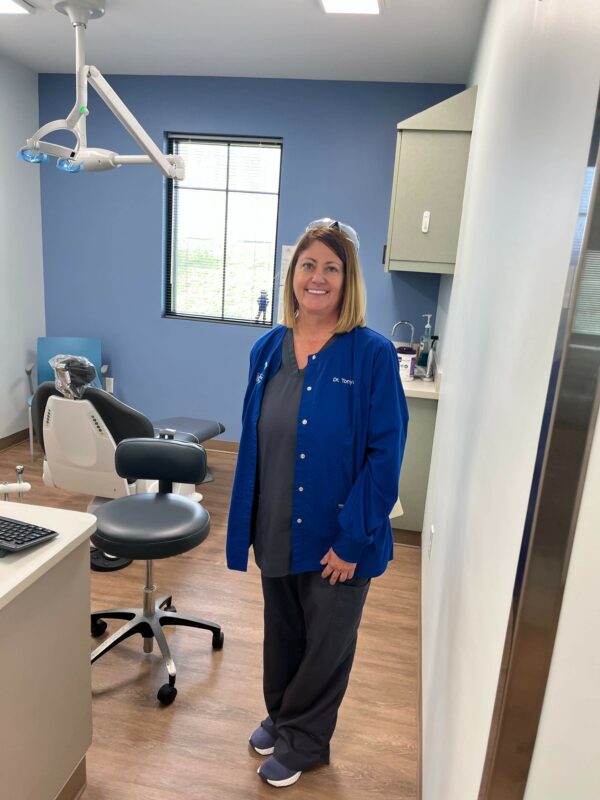
Tonya Kendrick is a pediatric dentist who was recently named the new CEO of the Post Clinic in Mount Sterling. Linda Blackford
Kendrick is such a believer in the Post Clinic that the board recently voted to make her the CEO, replacing long-time administrator Louise Summers, who retired after 14 years at the helm. Kendrick’s husband, who teaches at UK, helps out as well.
Continuity of care was a problem, Robert said, so the clinic hired a bilingual nurse practitioner, Olga Skinner, who works Monday through Thursday. There are consulting surgeons and volunteer doctors who can recommend further treatment for more serious problems.
The clinic also depends on a host of volunteers, who do everything from checking in patients to organizing the office. Michelle Romans has been working every Monday and Tuesday for the past six years, when her business, Lighthouse Candles, is closed.
“I love it, because if you can help you should,” she said.
What happens when Medicaid cuts kick in?
As one might expect, the clinic is beloved in Mount Sterling, supported financially by both city council and the Montgomery County Fiscal Court.
“We’re close enough to Lexington and bigger cities for the resources, like doctors, but we’re also in the Eastern Kentucky region, where the resources are needed,” said Haddix, the judge executive. “Dr. Roberts is a pioneer in this area — this is a relatively new concept, but once the word gets out, hopefully more could pop up.”
Earlier this year, the UK’s Gaines Center students did an oral history with patients and providers at the Post Clinic.
“I can’t say enough nice things about them,” said Tanya Lintner, a grandmother from Frenchburg. “They’ve been lifesavers actually, anything I need … they’ve been angels.”
Mayor Al Botts told me he’s proud the clinic is not solely dependent on government funds.
“Government can’t solve every issue,” he said. “To have a clinic like this to take care of the needs of many folks who have nowhere else to turn is something to be celebrated.”
In the end, the Post Clinic is at the center of a debate the Trump administration is bringing to the forefront of society right now, one we’re about to see play out. Should we have fewer safety nets from the government and more safety nets created by charity? Can communities pick up the pieces of providing health care when the safety nets are gone?
The clinic’s creator, Dr. Roberts, clearly thinks the system should be overhauled for a Medicare for all model. But as he said, “it would take citizens demanding it, and they need to demand it.”
Until that happens, however, the Post Clinic will keep serving patients.
“This is bigger and more than I ever thought it would be,” he said. “We’re the safety net of last resort.”