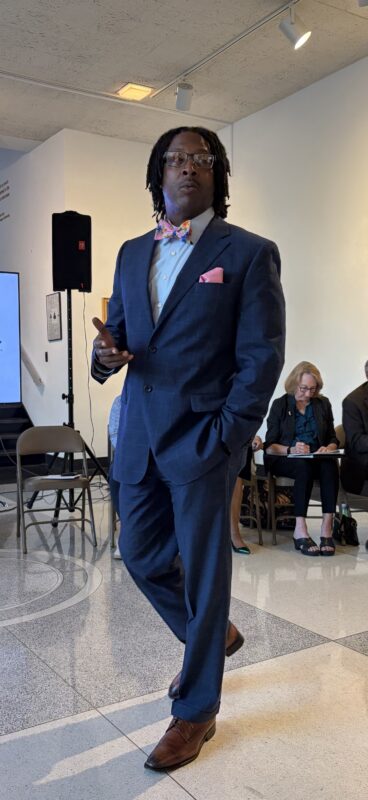
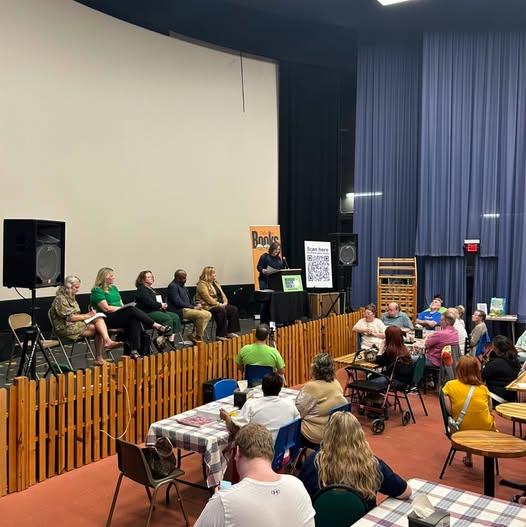
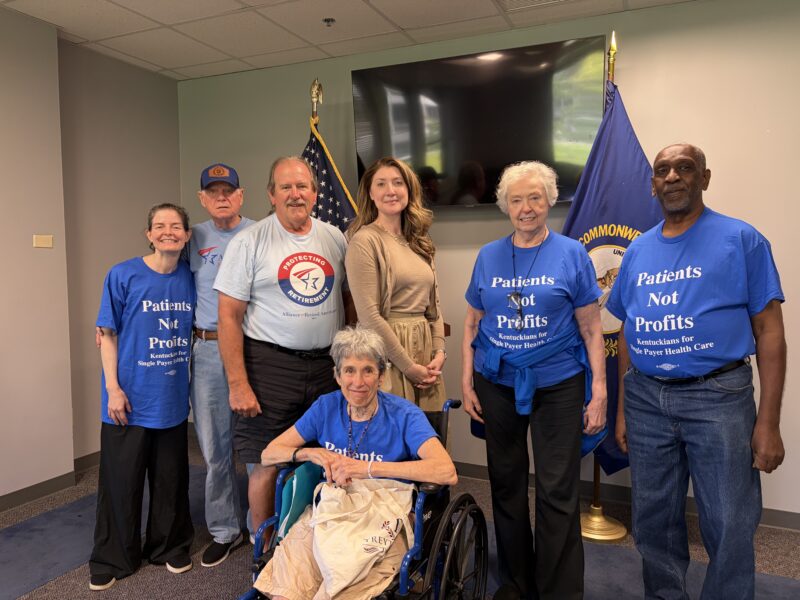
At the Oct. 1, 2026, Medicaid Listening Tour in Louisville, Dr. Swannie Jett, CEO of Park DuValle Community Health Center, was among the official speakers to describe the crises that will befall Kentucky and Louisville with the cutting of almost $1 trillion in Medicaid funds. He went further as he spoke of the need for a one payer system.
Community advocates spoke of the impact the cuts will have on those with low incomes and on the therapists and others who work to heal them.
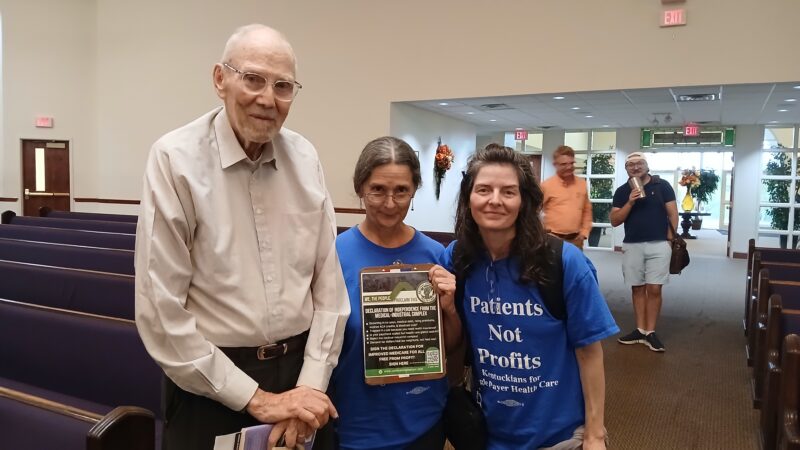
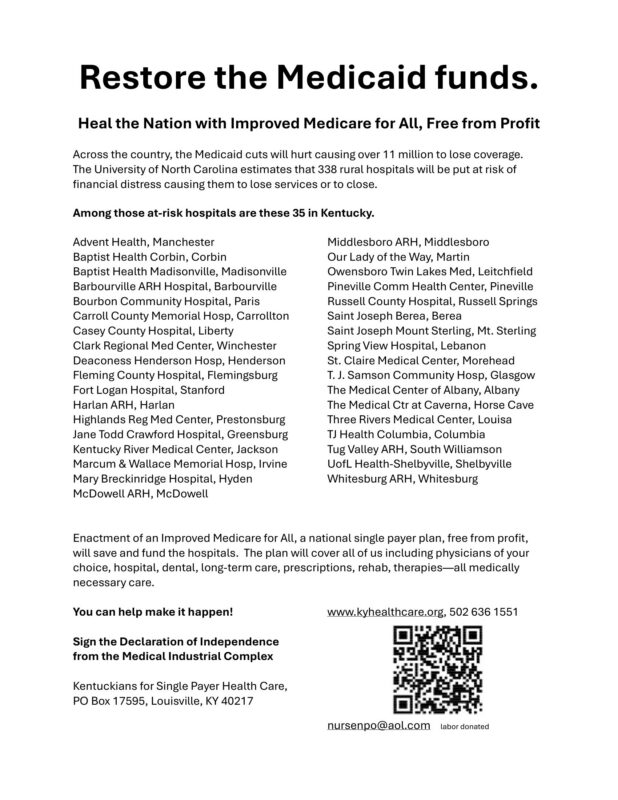
Kentuckians for Single Payer Health Care was there with their flyer listing the 35 Kentucky Hospitals at risk of closing and calling for the restoration of the Medicaid funds and the enactment of an Improved Medicare for All, free from profit. Jill Harmer spoke first, followed by Harriette Seiler, Paul Hoppe and Kay Tillow.
Kentucky Hospitals at risk of closing
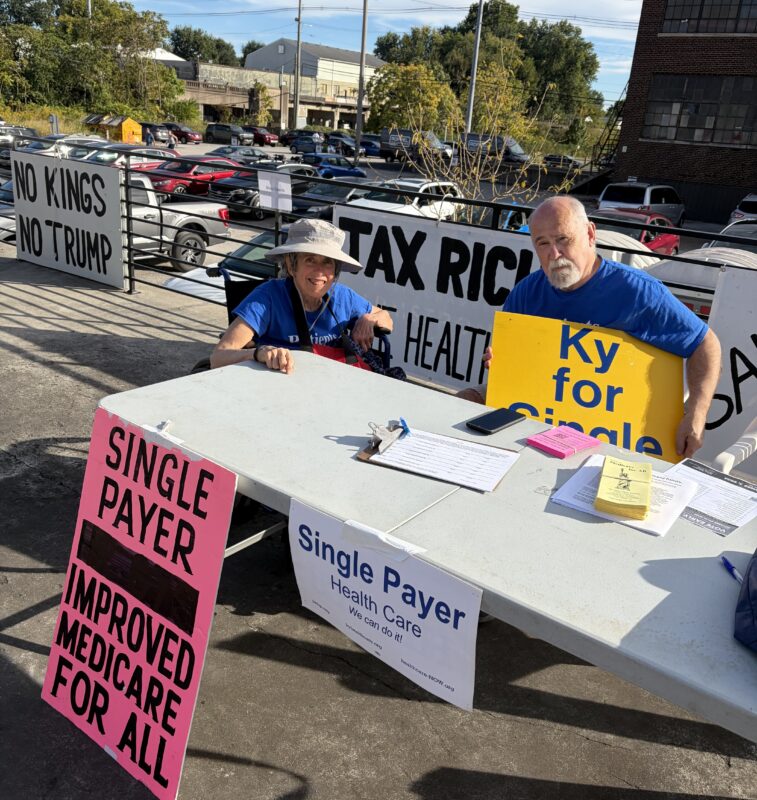
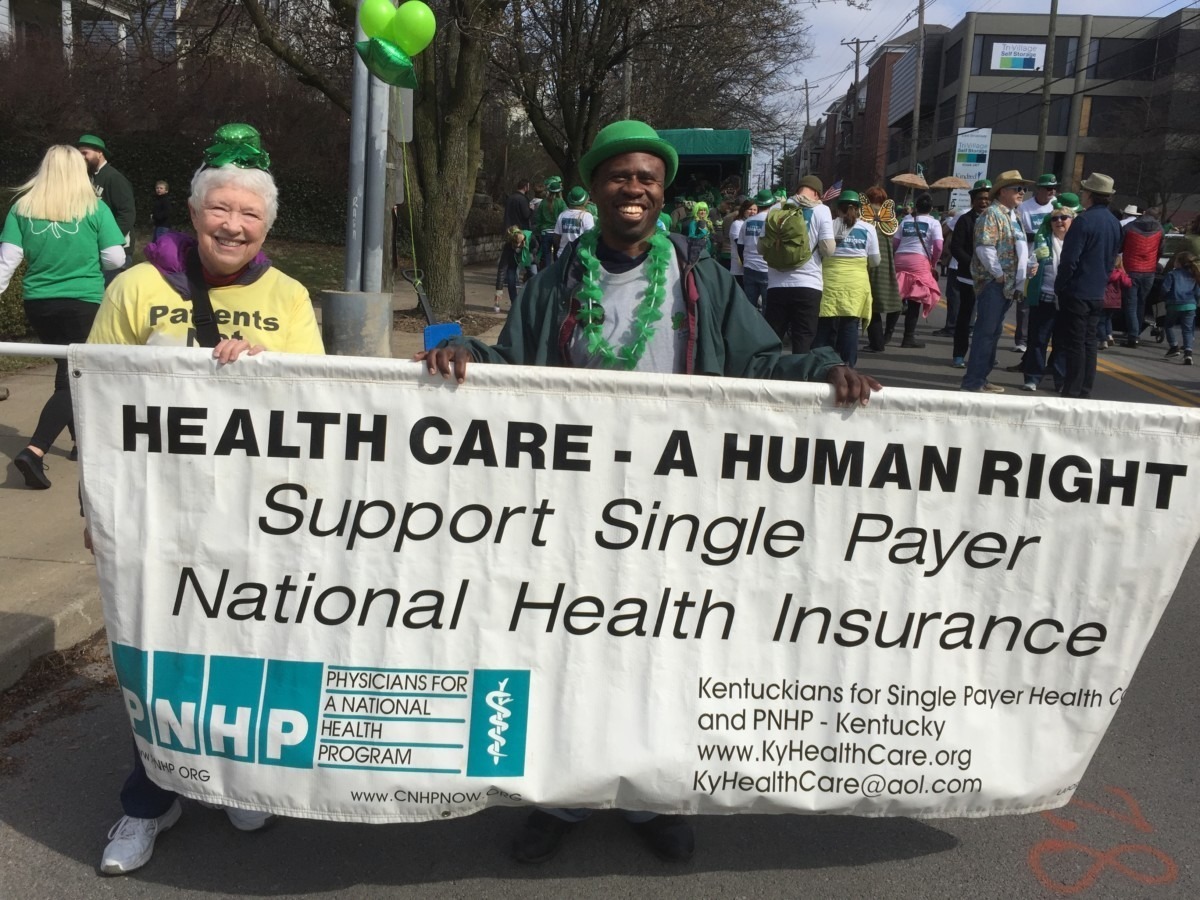
Jill Harmer and Paul Hoppe at the Oct. 3 Festival
Advent Health, Manchester
Baptist Health Corbin, Corbin
Baptist Health Madisonville, Madisonville
Barbourville ARH Hospital, Barbourville
Bourbon Community Hospital, Paris
Carroll County Memorial Hosp, Carrollton
Casey County Hospital, Liberty
Clark Regional Med Center, Winchester
Deaconess Henderson Hosp, Henderson
Fleming County Hospital, Flemingsburg
Fort Logan Hospital, Stanford
Harlan ARH, Harlan
Highlands Reg Med Center, Prestonsburg
Jane Todd Crawford Hospital, Greensburg
Kentucky River Medical Center, Jackson
Marcum & Wallace Memorial Hosp, Irvine
Mary Breckinridge Hospital, Hyden
McDowell ARH, McDowell
Middlesboro ARH, Middlesboro
Our Lady of the Way, Martin
Owensboro Twin Lakes Med, Leitchfield
Pineville Comm Health Center, Pineville
Russell County Hospital, Russell Springs
Saint Joseph Berea, Berea
Saint Joseph Mount Sterling, Mt. Sterling
Spring View Hospital, Lebanon
St. Claire Medical Center, Morehead
T. J. Samson Community Hosp, Glasgow
The Medical Center of Albany, Albany
The Medical Ctr at Caverna, Horse Cave
Three Rivers Medical Center, Louisa
TJ Health Columbia, Columbia
Tug Valley ARH, South Williamson
UofL Health-Shelbyville, Shelbyville
Whitesburg ARH, Whitesburg
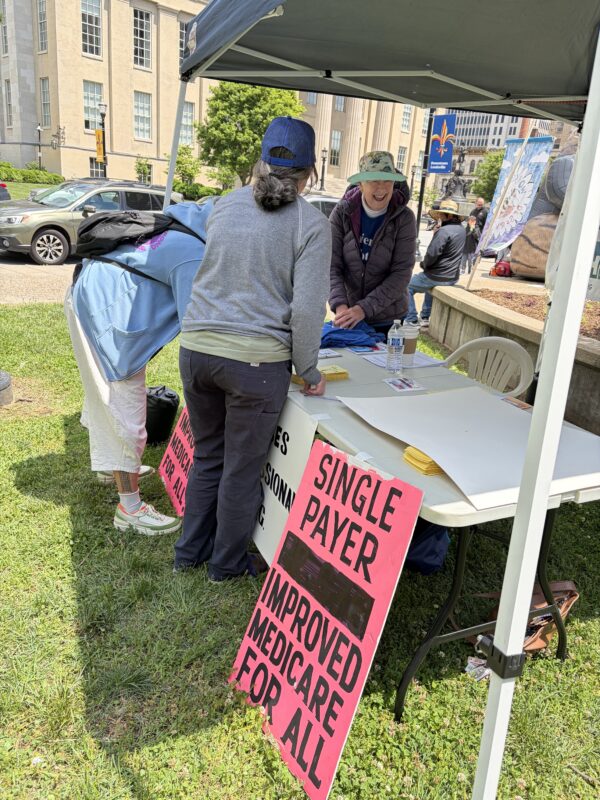
Two days later KSPH spent a glorious fall day reaching out to the public at the Oct. 3 Festival at the Trellis Brewery.
You can join in the activities, get on the mailing list for KSPH, or join the semimonthly internet meetings.
On Tuesday, September 22, Dr. Melissa Lucas and Paul Hoppe, members of the Steering Committee of Kentuckians for Single Payer Health Care, spoke at the Medicaid Listening Tour’s 3rd stop in Morehead, KY.
“My comments were well received, and many people approached me to talk afterwards,” Dr. Lucas reports.
Representative Lindsey Burke, who is the minority caucus chair from house district 75 in Lexington, moderated the event. Four other State Legislators were present, including Joshua Watkins, HD42 from Louisville. Lisa Lee, Ky State Medicaid Commissioner, was the featured speaker. Several speakers told their stories of how important Medicaid was to them and their families.
Paul had a table set with flyers that was well visited at the conclusion of the meeting with several signing our petition sheet in support of a national single payer plan.
The final stop for the Medicaid Listening Tour will be in Louisville on Thur., Oct. 1, 2026, 6-7:30 PM:
Simmons College, Admin & Library Bldg, President’s Hall, 1000 S. 4th St.
We have cancelled our Oct. 1 KSPH meeting so that we can go and speak for restoring the Medicaid cuts and enacting Improved Medicare for All.
Apparently, the senator thinks that the 180 million Americans who rely on job-based insurance would be upset if our system were changed to cover everyone.
A proponent of Medicare for All wrote to Sen. Mitch McConnell advocating for a single-payer health care system.
McConnell’s office responded in support of the current multi-payer, profit-based health system.
McConnell’s spokesperson reportedly referred to the proposal as a “socialist scheme” that would increase taxes on the middle class.
In July, I wrote to Sen. Mitch McConnell (a) to wish him a speedy recovery from a serious health episode, and (b) to call for major reform of our dysfunctional health care system.
As a congressman, the senator benefits from dependable health insurance, with quality care and coverage for rehab — all funded by taxpayers. Unfortunately, working/middle class Americans, even those with insurance, cannot count on access to the same level of care. Private insurers have been denying needed treatment and limiting rehab days.
In my letter to the senator, I urged support for a national, publicly funded, single-payer, Medicare for All system, free from profit.
I received an email response, dated July 20, 2026, bearing the senator’s signature. The text of the letter clearly stated the senator’s support for our current profit-dominated, multi-payer health system.
Health coverage for all
Apparently, the senator thinks that the 180 million Americans who rely on job-based insurance would be upset if our system were changed to cover everyone. According to a 2025 survey by the Kaiser Family Foundation (KFF), the cost of employer-based overage for a family of four was $26,993, with the worker paying $6,850 of that total. That may sound like a “deal” but with deductibles rising, not all workers consider their share affordable. We should also remember all the businesses that do not offer health benefits to their workers.
Dare one mention the recent ACA marketplace changes, the harsh cuts to Kentucky Medicaid, the estimated 28 million who remain uninsured?
The senator doesn’t seem to realize that, under Medicare for All, every U.S. resident would be covered for all needed care, including dental, vision, mental health and nursing home care. There would be choice of doctor, no network restriction, no premium, no deductible, no bill in the mail.
Relief from the burden of medical bills
In the text of the response to me, Sen. McConnell’s spokesperson twisted “Medicare for All” into “Medicare for none,” calling my proposal a “socialist scheme.” (President Truman’s commented that socialism as a “scare word” used by political opponents to attack popular government programs that help everyday citizens.) Moreover, McConnell appears to think an improved and expanded Medicare would “dramatically increase taxes on the middle class.” One wonders how many Americans would gladly pay slightly more in taxes if they got health coverage but were relieved of the burden of paying for health insurance premiums and medical bills?
Several economists have said that single-payer Medicare For All would save money.
Sen. McConnell, his staff and Courier Journal readers might consult the results of an April 30, 2026, Kaiser poll which gives an overview of how Americans are coping with rising health care costs.
On Sept.14, McConnell returned to the Senate, saying he felt well enough to vote and take up his committee duties.
Harriette Seiler, born and raised in Canada, naturalized as a U.S. citizen in 1978, has many relatives who have been well served by Canada’s Medicare. She currently serves as secretary for Kentuckians for Single-Payer Health Care.
On September 17, 2026, Justin Garrett, medical student at the Kentucky College of Osteopathic Medicine in Pikeville, spoke at the Medicaid Listening Tour in Prestonsburg. He is the president of the chapter of Students for a National Health Program (SNaHP).
Justin reports:
I tried to firstly address the controversy between Barr and Beshear on the validity of the claims made that 35 hospitals in Kentucky were at risk of closing due to the cuts in Medicaid.
I then briefly mentioned some statistics on how poorly Kentucky ranks compared to other states in overall Healthcare and how it would affect Kentuckians if these hospitals were to close.
I then transitioned to talk about Medicare for All and how Americans would benefit from it, and closed my speech by bringing up a study that showed we would save money by switching to M4A.
After the event, we talked with the panelists and had pleasant exchanges with many of them as well as the other listeners/speakers that shared stories. I also met with Ned Pillersdorf afterward, and he congratulated us on our work back in July and made it a point to say he would like to try to work with us on an event in the near future at Upike!
Paul Hoppe, member of the Steering Committee of Kentuckians for Single Payer Health Care, was the first speaker at the Prestonsburg event. Paul reports:
Representative Lindsey Burke, who is the minority caucus chair from house district 75 in Lexington, moderated the event in the absence of Dustin Pugel.
Steve Bechtel, chief financial officer, Kentucky Department for Medicaid Services was the featured speaker and spoke on the real dollar shortfalls facing the Kentucky Medicaid Program.
Also, in attendance was legislator Joshua Watkins, who is the minority whip from Louisville and 3 other state legislators representing Frankfort and Lexington. As usual, Justin gave a very good talk concerning the overall disaster unfolding with the Medicaid cuts.
I spoke specifically on the impact of the forecasted hospital closings. At the end Mr. Bechtel approached Justin, Phyllis, and I, thanking us for participating and shared that the Sheps study is absolutely correct and he has the numbers to prove it.
He also said the results of any closings or even downgrading of services I outlined were accurate.
You can watch a brief video with Paul and Justin at this link:
On Thursday, September 10, 2026, Kentuckians for Single Payer Health Care was there for the Medicaid Reality Check Listening Tour at the Consolidated Baptist Church in Lexington.
Susan Hills reports: “Kitrina made a powerful statement and was among the few that got applause, and we talked to lots of folks afterward, handing out flyers and getting folks to sign.”
L to R: Robert Toon, MD, of Mt. Sterling, Kitrina Kearfott, MD, of Lexington, and Susan Hills from Louisville.
This was the first of the Medicaid events, sponsored by the Kentucky Senate and House Democratic caucuses, to hear from the public about the impact of the cuts that result from the federal legislation, HR 1. That bill will take $1 trillion from Medicaid over 10 years and will endanger 338 rural hospitals including 35 in Kentucky.
This is the schedule for the remaining events:
Prestonsburg, Thur., Sep. 17, 6 pm to 7:30 pm Eastern, Gearheart Aud, Big Sandy Com and Tech College, 1 Bert Combs Dr;
Morehead, Tue., Sep. 22,6 pm to 7:30 pm Eastern, Fuzzy Duck Coffee Shop, 159 E. Main St;
Louisville, Thur., Oct. 1, 5:30 to 7:45 pm, Simmons College, 1000 S. 4th St, Louisville, KY
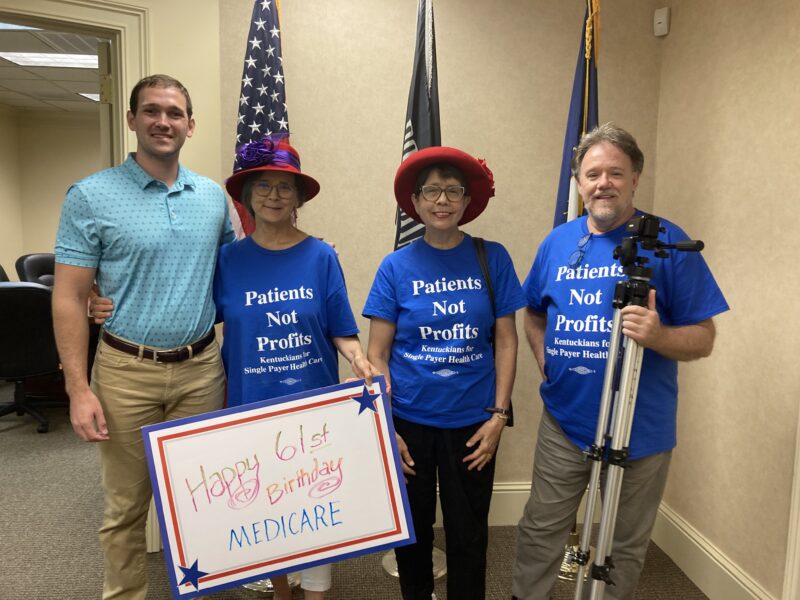
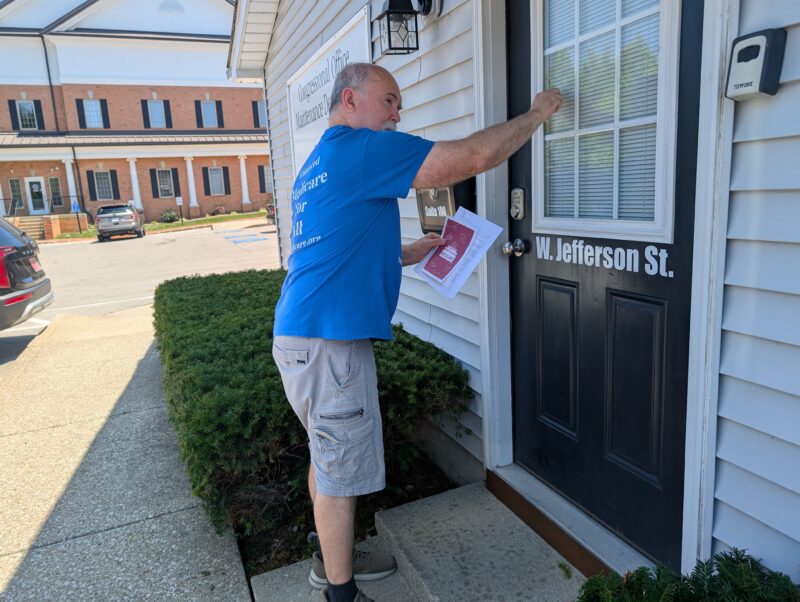
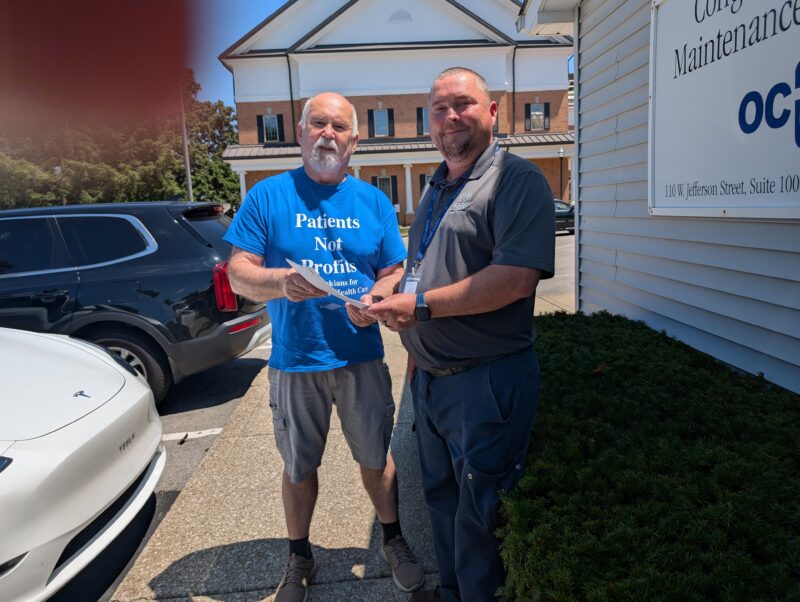
On July 30, 2026, Medicare’s 61st birthday, Kentuckians for Single Payer Health Care delivered a demand for passage of Improved Medicare for All to Congresspersons in four Kentucky Congressional Districts.
The deliveries took place at the Prestonsburg office of Rep. Hal Rogers of the 5th Congressional District, at the Lexington office of Rep. Andy Barr of the 6th CD, at the LaGrange office of Rep. Thomas Massie of the 4th CD, and at the Louisville office of Rep. Morgan McGarvey of the 3rd CD.
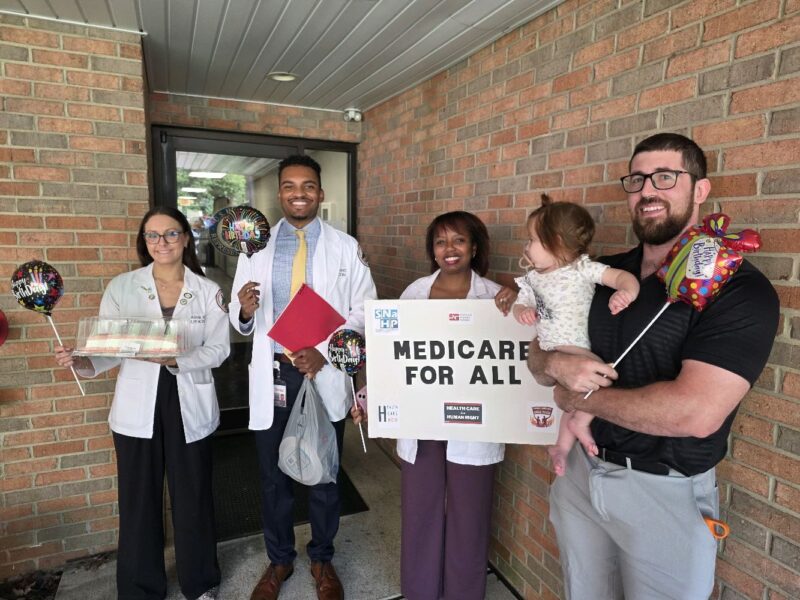
Pikeville’s Mountain Top News covered the event in Prestonsburg and interviewed medical student Justin Garrett who said, “In the U. S., we have more money in health care but worse outcomes–Medicare for All would do a lot for every American.” Garrett is president of the Students for a National Health Program at the medical school in Pikeville. His delegation brought a birthday card signed by dozens of medical students as well as a birthday cake and balloons.
Advocates in all four districts brought a letter supporting Medicare for All which has been signed by over 335 organizations nationwide and urged the Congresspersons to support HR 3069, the single payer legislation that will assure health care to everyone in the United States, remove all economic barriers to care, and save our rural and other hospitals that are under threat of closure.
Justin Garrett, 2nd from left, and his group at the office of Rep. Hal Rogers in Prestonsburg.
The letter says, in part:
Now is the Time for Medicare for All
If we do not inspire, energize, and organize the largest grassroots movement in history, including the multiracial working class, everyday Americans, and everyone else hurt by our broken health care system, by demanding real material changes like Medicare for All, then we risk losing millions more people to the false promises of authoritarians and their corporate allies.
An Open Letter to those seeking to reform our health care system: Dream Bigger, Be Effective:
Our Democracy is struggling, and the status quo is not working. Too many corporate-backed politicians continue to push for a “business as usual” approach while wages stagnate, public goods and services erode, and billionaires amass grotesque amounts of wealth.
L to R: Craig Shockley, field representative for Rep. Andy Barr, Kitrina Kearfott, MD, Nancy Crewe, and Mark Spencer. Kitrina Kearfott and Nancy Crewe organized this Lexington event.
The letter continues:
The reality that far too many live today is one of debt and struggle. Working people feel a deep sense of alienation and powerlessness due to the state of our economy, which is rigged to benefit corporations and wealthy elites. How can one feel optimism for our future when over 40% of us are carrying around the burden of medical debt? How can we plan for our futures when we can’t afford to go to the doctor or cover rent?
…It’s time to challenge the corrupt CEOs who profit off despair. To show people real solutions that can work. No one can fix our rigged economy overnight. Our structural inequality is decades in the making. But one piece of the solution is to take on one of the largest industries in our country: health care.
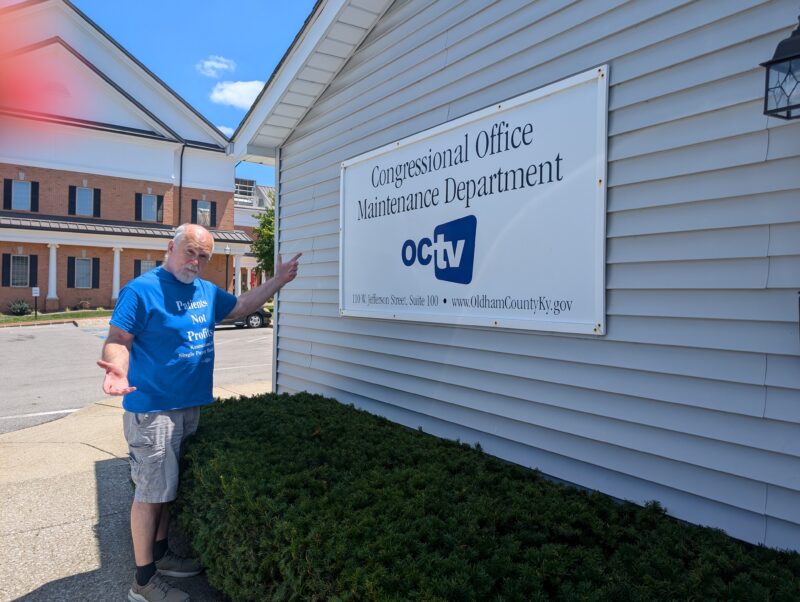
(Below: Paul Hoppe, member of Kentuckians for Single Payer Health Care Steering Committe, delivering the Medicare for All message to a worker at Rep. Thomas Massie’s very small office in LaGrange. Melissa Lucas, MD, of Lakeside Park in Massie’s District 4, sent a letter that Paul delivered. Her letter states:
Dear Representative Massie,
I am a constituent from district 4 and it’s time for me to write you about our healthcare crisis. As a recently retired physician, I have grappled with our current dysfunctional system daily and can tell you there is no fixing it. We have the most expensive bad healthcare system in the industrialized world and tinkering around the edges will only make it worse.
In particular, Medicare Advantage siphons off billions directly to private corporations who provide nothing of value to American taxpayers. I personally wasted hours of time trying to get insurance companies to reverse their denial of medical services and provide the medical care they had already been paid for. Medical care delayed is often medical care denied. Insurance companies profit handsomely while bankrupting our Medicare Trust Fund.
The answer to this egregious waste of taxpayer money is a single payer healthcare plan free of profit. Responsible estimators predict we can save 650 billion annually and increase coverage to everyone and improve quality. A majority of the public is now in favor of a single payer system.
I urge you to support House Bill 3069-perhaps even cosponsor it. Do not waste more time trying to tweak our current system. Be a leader in healthcare reform!
Sincerely,
Melissa Lucas, MD)
More of the national letter:
We must dream bigger. In fact, 90% of Democratic voters and 63% of all voters support Medicare for All. Americans believe the government should guarantee health care to everyone, and anything less means tens of millions of people in the U.S. continuing to suffer from the lack of necessary care and the prospect of medical debt if they do seek care.
The Louisville delegation had a great meeting with Rep. Morgan McGarvey’s staff director, Amy Washburn, who expressed strong support for Medicare for All. Jill Harmer is in the front row. Back row L to R: Susan Hills, Steve Barger, Kirk Gillenwaters, Amy Washburn, Kay Tillow, and Ralph Hearn.
We can’t give in to half measures; we must fight for exactly what people need and deserve.
Medicare for All is the only way that we can guarantee everyone’s care and finally take the profit-motive and corporate influence out of health care.
…We urge members of Congress to stop listening to the political consultants and start listening to the people. Americans understand we must get corporate greed out of our health care system once and for all. Meet the moment: Join the fight for Medicare for All
We may face a once-in-a-generation opportunity to legislate on health care in 2029. We need to rally behind the boldest possible reform, Medicare for All, that brings together the broadest possible movement, not overly complex incremental measures that prop up the same systems ….
The American people are hungry for bold ideas that reform fundamental institutions that have failed them for too long. And they are looking for leaders who will take on powerful interests and fight for working people.
Now is the time to organize and inspire! Support for Medicare for All grows daily in our communities and in Congress. It’s our best path forward, and it’s rooted in real promise: everybody in, nobody out.
The actions are a part of similar efforts in scores of cities across the country from Seattle to Portland, Maine, and from Grand Rapids to Houston. A map of cities where actions occurred is here: https://act.medicare4all.org/event/doa/
HR 3069, Improved Medicare for All, national single payer bill, currently in the House, which needs to be improved to ban and convert the for-profit hospitals, nursing homes, dialysis centers, etc.
HR 676, Expanded and Improved Medicare for All, a model single payer bill in the House from 2003 to 2017.
Please support the work of Kentuckians for Single Payer Health Care by making a donation on line here. Or you can mail your check to KSPH, PO Box 17595, Louisville, KY 40217. Annual dues are $5, but we welcome whatever you can give.
On July 21, 2026, Harriette Seiler and Kay Tillow dodged statewide thunderstorms and tornadoes to arrive in Morehead for a program on “Nothing Less than Improved Medicare for All Can Heal the Nation.”
Improved Medicare for All, free from profit, is also called national single payer and would provide coverage, publicly funded, for everyone in the United States removing all copays, deductibles, and premiums assuring that there are no financial barriers to care.
The slide show was followed by a lively question and answer session.
Morehead is located in eastern Kentucky in the 5th Congressional District where 16 of its rural hospitals are at risk of closure according to a list released by Senator Edward Markey.
The Coalition of Labor Union Women passed a resolution calling on the Congress to save our rural hospitals by enacting single payer health care. Learn more about the campaign to save rural hospitals with single payer here. The legislation for Improved Medicare for All in the House is H.R. 3069, sponsored by Rep. Pramila Jayapal and Rep. Debbie Dingle.
A similar presentation, free of charge, is available to any Kentucky organization. Just let us know at nursenpo@aol.com.
If you’d like to get involved in the unfolding battle to enact national single payer for our country, join our meetings on the 1st and 3rd Thursdays of each month at 5:00 pm eastern. Email Kay at nursenpo@aol.com to get on the list to receive the zoom link.
If you haven’t yet signed the Declaration of Independence from the Medical-Industrial Complex, please do so.
Here’s the video with the “Now is the Time for Medicare for All” hearing from July 22, 2026 featuring Rep. Jayapal and many other advocates and representatives.
Kentuckians for Single Payer Health Care thanks Iva Markicevic Daley for making the arrangements, organizing the publicity, and mastering the computer/projector technology for the program.
“Nothing less than Improved Medicare for All can heal the nation”
The public is invited to join us on Tuesday, July 21, 2026, at 5:30 pm, at the Rowan County Public Library, 175 Beacon Hill Rd, Morehead, KY 40351, for a presentation on Improved Medicare for All, a national single payer plan, free from profit, that will provide high quality coverage for all and remove all financial barriers to care while saving our rural hospitals.
The United States spends twice as much on health care, per capita, as other wealthy nations, yet many go without care because of cost–even millions who have insurance. Fifteen million more are expected to lose coverage as new laws kick in.
Learn of the energetic, new push to achieve a national Medicare for All, free from profit, in the United States.
Presentation by Kentuckians for Single Payer Health Care followed by discussion and Q & A.
Kentuckians for Single Payer Health Care is affiliated with Physicians for a National Health Program http://www.pnhp.org