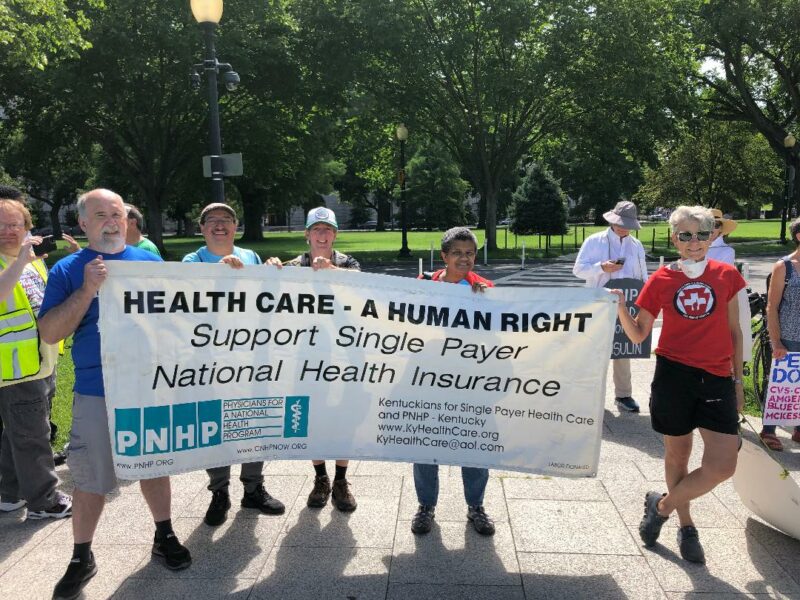
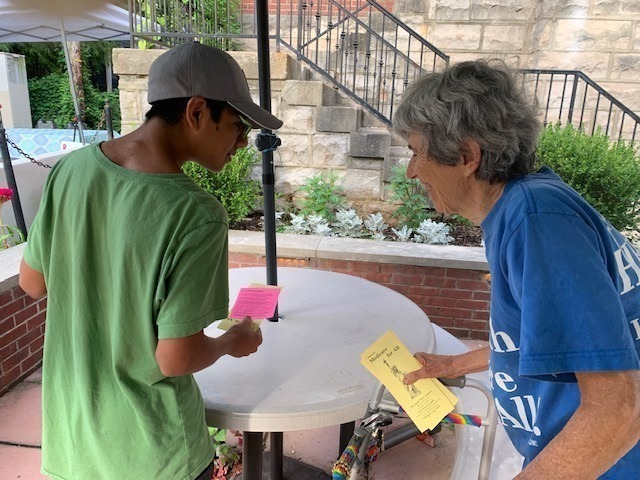
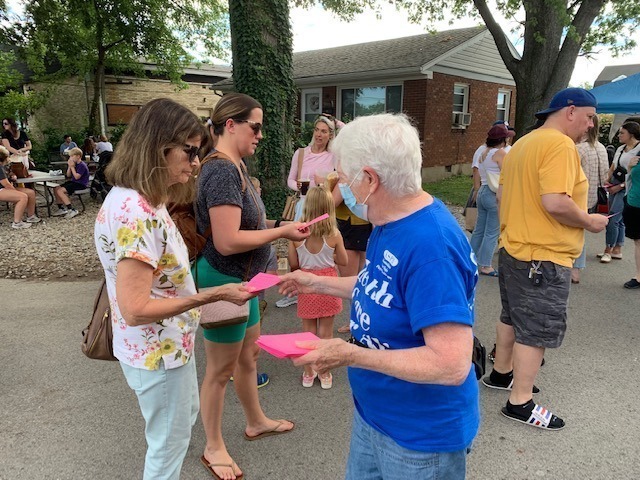
On July 24 Marchers for Medicare for All took to the streets in Louisville and 55 other cities

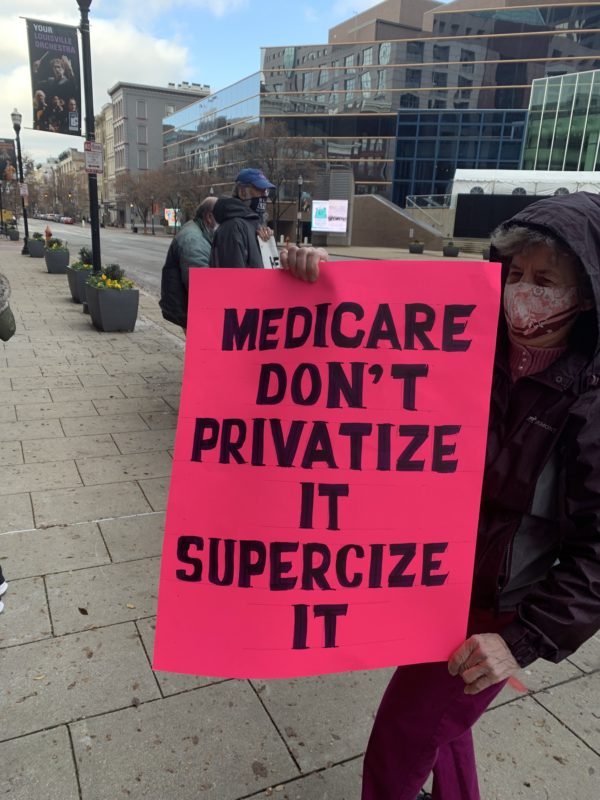
On July 24, 2021, many thousands of people in 56 cities participated in the March for Medicare for All, initiated by a new coalition that called for urgent action for health care as a human right and a basic freedom.

How can we have life, liberty and the pursuit of happiness when we live in constant fear of illness, bankruptcy, or homelessness because of the outrageous for-profit healthcare system,” said the coalition.  “One event can ruin your life, even if you have insurance.  The industry can always say ‘no.’ We need a big fat ‘yes’!

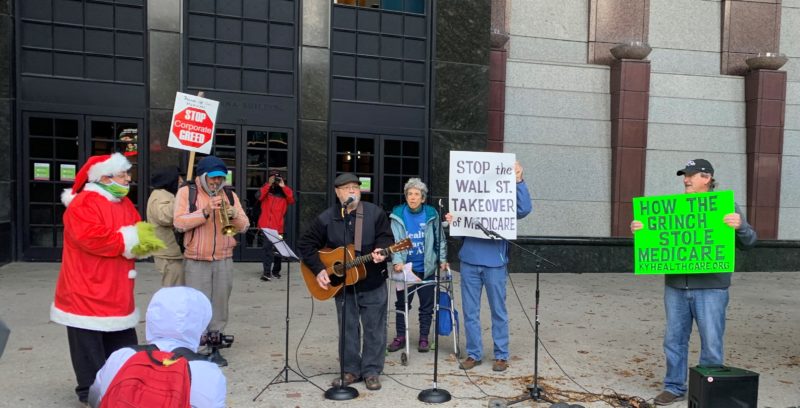
Kentuckians for Single Payer Health Care (KSPH) brought together a coalition of 23 organizations to cosponsor the Louisville event on the lawn of the Mazzoli Federal Building.

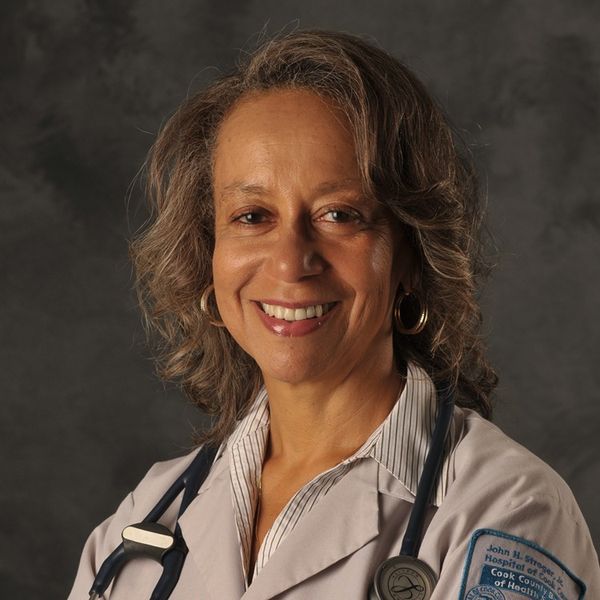
Ann Hagen Grigsby

Ann Hagan Grigsby, (photo left) President and CEO of the Park DuValle Community Health Center opened with a call for single payer health care.  Her foster mother, she said, died before the age of 65 from lack of health care, “and it’s still happening today.”

Speaking as an individual, she said that even though her clinic is a national quality leader, it still cannot fill the gaps that patients face.  “What happens when you need a surgeon?   What happens when you can’t afford all the medications that you need.?”

“Until we as a people decide to tell members of Congress that the system is broken, that we will not take it anymore, it will not change.  We need to put people before profits,” she concluded.

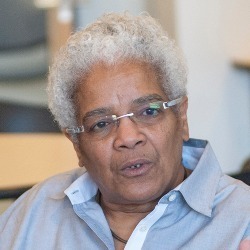
Greg Tichenor, Board Member of the Kentucky Alliance Against Racist and Political Repression (KAARPR), said, “We as a society have accepted some people as disposable.  Money interests cannot be louder than the peoples’ interests.”  He called on the crowd to make their voices heard with their representatives and at the ballot box.

Marcellus Mayes, President of the Metro Disability Coalition spoke “as a blind American and a Kentuckian representing people with multiple sclerosis, muscular dystrophy, Parkinson’s disease, developmental disabilities, stroke patients, cerebral palsy and all who have pre-existing conditions.  Single payer health care is essential and necessary for people like me and those I associate with,” he said.  “We as Americans should all look to each other, nobody should be treated differently whether you are gay, straight, disabled or otherwise.”

“We claim to be a compassionate city, but so many people are being left behind” he said.  “You need to show us grace and mercy and provide us with single payer health care.”

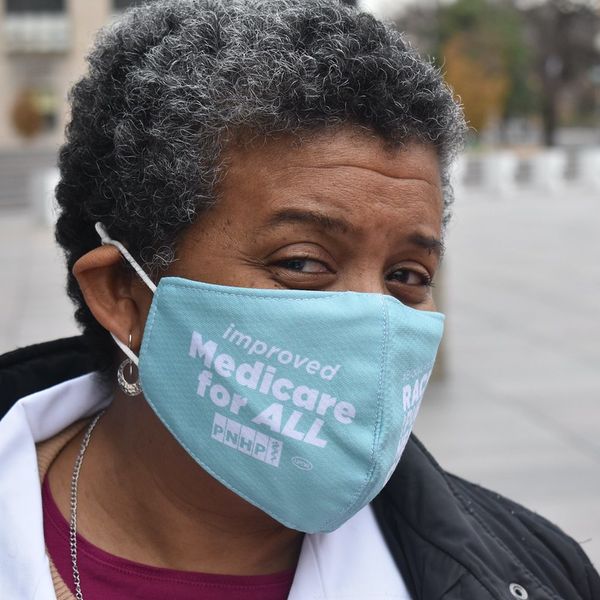
Patricia Bautista-Cervera, MD, MPH, Community Liaison and Health Empowerment Coordinator at La Casita Center, explained why the Center is advocating for a single payer national health care system.

“The community we serve, is composed of essential workers: restaurant, factory, cleaning services, construction, yard work.  All these workers have continued to work their job sites,” she said.  “The pandemic has brought for those affected an increase in medical bills, loss of income or the loss of jobs due to the economic crisis that resulted from it.  Most of them don’t have health insurance.”

“According to a recent report, the debt owed to collection agencies by Americans stemming from medical care is 140 billion dollars. What I have described represents an enormous problem, imagine if we make it worse by adding several layers of barriers such as language, culture, education, income and the history of confronting traumatic events.”

She spoke of the Center’s organization of seven successful vaccination clinics that distributed 1,169 vaccines.  “Health care is a human right,” she said,  “Let’s keep working together to achieve this common goal.”

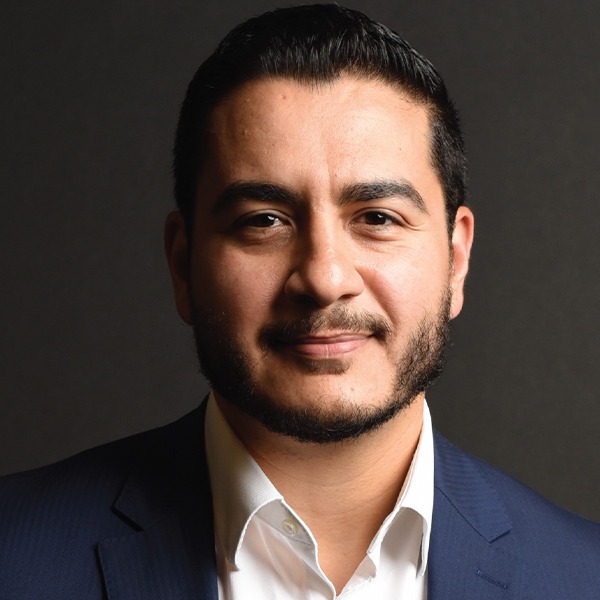
Bill Londrigan, (photo right) President of the Kentucky State AFL-CIO, noted that over 607 union organizations including 146 central labor councils and 43 state AFL-CIO federations had gone on record in support of national single payer health care legislation. Bill Londrigan, President, Kentucky State AFL-CIO

“I am really proud to say that the Kentucky State AFL-CIO was the first of the state federations to support single payer.”

He spoke of the difficulties in bargaining for wages, retirement, and other benefits because health care costs continue to skyrocket.  “What we want to do is take health care off the table.”

“We are absolutely tired of this corrupt system which is based on greed.  We need to take that profit motive out.  We need to stop paying CEOs tens of millions of dollars.  We need to stop these corporations from lowering benefits and denying people care.  This is wrong and that’s why our cause is so positive and so great.”

He pointed to other current issues such as the PRO act which would make it easier for workers who want to organize to have an opportunity to do so.

He urged everyone to support single payer, Medicare for All, and “get it through congress so we can transform this nation into one that stands with people instead of trying to deny them this basic right.”  He ended by saying “And we will win.”

Rev. Ron Robinson, a member of the steering committee of KSPH, stated that this Kentucky single payer group has been working on this issue since 2003.

“We’ve been in a war of consciousness over this immorality,” he said.

“You are the foot soldiers of consciousness.  When this war is won, then the disenfranchised will have access to Medicare.  When this war is won everybody will be able to go and say I need help and the doctor won’t say how much insurance do you have.”

“Like John Lewis said, we’re going to make good trouble.”

Kirk Gillenwaters, President of the Kentucky Alliance for Retired Americans, said that his organization represents retired union workers of Kentucky.  “One of the things about being unionized, we’ve all been receiving the benefits of a defined medical benefit.  Even though we are blessed with having the quality of life that we have, we know that this can be reversed and taken away with just the stroke of the pen, by denying us our secondary health care.”

He said that his United Auto Workers Local 862 was one of the first unions to join up with Medicare for All.  “That was almost twenty years ago.”

He spoke of the profits in medicine.  “You look at the top providers that manage our health care.  Humana hit $471 per share of stock yesterday.  United was $417.  Blue Cross Blue Shield $387.  That’s the profit off of our backs and the benefits that we’re supposed to be having—by the profit that they’re taking out of our health care.  This is why we’re asking for change.”

Garrett Adams, MD, MPH, former President of Physicians for a National Health Program, was the last rally speaker.  He noted that this month marks Medicare’s 56th birthday.

“We recently celebrated Juneteenth, the day honoring the end of slavery, the end of the despicable practice of buying and selling people as commodities, trading people as a business.

“Today all Americans are once again under the thumb of people who want to profit from us, the medical-industrial complex.  Health insurance companies, medical supply companies, and big Pharma.  We must throw off the yoke of business profiteering on health care.”

He said that several years ago the CEO of McKesson, a medical supply company had take home pay of $148 million.

“We must focus on health care not wealth care.  That is improved Medicare, comprehensive, high-quality care, including dental, vision, hearing, mental health and long term care paid through a national plan.  Privately delivered but paid for by our government.  The economists repeatedly have shown that we can afford this.  And the people including an increasing number of physicians want it.  We must build the political will to demand it.”

The participants, banners unfurled, then marched the half mile to Breewayy, Jefferson Square Park, where KAARPR had assembled large portraits of Breonna Taylor, who was murdered in her home as police carried out a baseless no-knock warrant.  There Mary Radford, RN, member of the KSPH Steering Committee, placed flowers in her memory and spoke:

“As an EMT and former Emergency Room Tech, Breonna undoubtedly experienced firsthand the consequences of a healthcare system that consistently failed the most vulnerable of our citizens. Based on everything I have learned about her, I have no doubt she served our community with grace, and empathy. I’ve also learned that the next step in her life of service was to become a nurse, and I can say with confidence I would have been proud to have her as a colleague.

“And while we take this moment to honor this Louisvillian, this Kentuckian, this hometown hero: taken from her family and her community through police violence, we also acknowledge the multiple black lives that have been taken in similar travesties throughout this nation.

“Through an unjust healthcare system, through gentrification, through police brutality and so many other ways, our fellow Americans are dying. We cannot stand for this any longer.”

The marchers returned to where they began.

The national March for Medicare for All continues the struggle with a human rights violation complaint to be submitted to the United Nations and the planning of a public UN panel discussion.

Harriette Seiler has put together a collection of photosSpectrum News covered it.  So did WLKY.  Rolf Friis, an independent Louisville videographer, showed the rally live on Facebook and put it on youtube.

Share and Enjoy !

Shares

Louisville and 54 other cities plan March for Medicare for All, July 24, 2021

Rally and march for improved Medicare for All.

Sat. July 24, 2021, at 11 AM

Mazzoli Federal Bldg., 600 Dr. Martin Luther King Jr. Pl.

We will begin at 11 AM in the park in front of the Federal Building where we have permission from the city to use the site.  We will set up under the trees near the corner of 7th & Chestnut so speakers and participants alike will be in the shade.

We will have speakers (brief) and music then march and/or caravan to Breewayy, the square at 6th between Liberty and Jefferson.

There we will place flowers in honor of Breonna Taylor, to connect with her profession as a healer, and to link the struggle for health care with the fight to end systemic racism.  We will return to where we began and share refreshments and socialize.

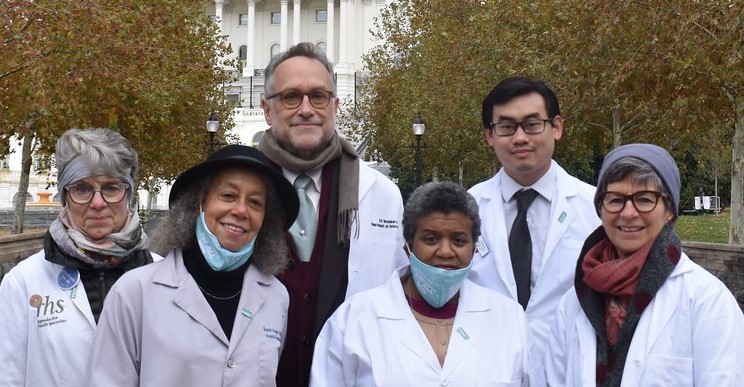
University of Louisville medical students advocating for single payer health care

We will also be celebrating Medicare’s 56th birthday.  We hope you will join with us in demanding that Congress take action by passing a national single payer, improved Medicare for All plan.  Such a plan would end the tragic denial of care that causes so much suffering and unnecessary loss of life.

Cosponsors: (list in formation)

Kentuckians for Single Payer Health Care, Physicians for a National Health Program-KY, Kentucky Alliance Against Racist and Political Repression, Greater Louisville Central Labor Council, Independence Seekers, Movement for a People’s Party-KY, Clifton Universalist Unitarian Church, Kentucky Alliance for Retired Americans, Metro Disability Coalition, UAW Local 862, Central Kentucky Council for Peace and Justice, Anne Braden Institute for Social Justice Research, Carl Braden Memorial Center,  Association for the Study of African American Life and History, La Casita Center, Louisville Fellowship of Reconciliation, Fairness, Louisville Showing Up for Racial Justice, Kentucky State AFL-CIO, LIUNA Local 576, Lexington DSA, Sowers of Justice, Louisville State Chapter of the National Action Network

National Events list.

The national website is here

Further info:  Kay Tillow (502) 636 1551, nursenpo@aol.com

Print the flyer

Share and Enjoy !

Shares

People in other countries find the U. S. healthcare system is shockingly inhumane—a 6 minute video from NY Times Opinion.

“Why is it so expensive?”

https://www.nytimes.com/2021/04/28/opinion/healthcare-us.html?action=click&module=Opinion&pgtype=Homepage

Play video.

Byzantine health plans. Impoverishing deductibles. Exorbitant drug costs. Soul-crushing surprises lurking in the fine print.

The American health care system is — to put it mildly — totally perplexing, an exercise in patience and a test of financial resilience.

And that’s for its participants.

So imagine what the system must look like to people from other countries, especially those with universal health care, where citizens don’t live in fear that the next bout of the sniffles might somehow lead to bankruptcy.

In the video above, we gathered people from around the world and introduced them to the American health care system. We presented them with dizzying examples of insurance plan options. We showed them how much medical services cost. And we revealed some of the survival strategies of the tens of millions of Americans who are uninsured (drug purchases in Mexico, GoFundMe campaigns, consultations with “Dr. Google”).

Share and Enjoy !

Shares

President Biden’s health care tweaks will perpetuate expensive mediocrity

Jill Harmer, Antonio Wilson and Harriette Seiler at a KSPH meeting

At Last, Democrats Get Chance to Engineer Obamacare 2.0

The Biden administration is trying to make the health care law more generous and closer to its original design, but may disappoint progressive allies hoping for more.

By Sarah Kliff and Margot Sanger-Katz
The New York Times, February 27, 2021

Full story.

With comment by Don McCanne, MD

Share and Enjoy !

Shares

The Private Health Insurance Industry: Should It Be Eliminated? John Geyman says “Yes” and Gives the Compelling Reasons.

38183622634_0075b56686_k

Many Americans assume that the private health insurance industry is an unmovable fixture in the U. S. health care system, but there is a growing need to re-examine that premise. Over recent decades, its performance has been increasingly profit-driven to the point of now becoming unaffordable for patients, their families, employers and taxpayers.

Full story.

John Geyman, M.D. is professor emeritus of Family Medicine at the University of Washington School of Medicine in Seattle, where he served as Chairman of the Department of Family Medicine from 1976 to 1990. His most recent publications are Struggling and Dying under TrumpCare: How We Can Fix this Fiasco (2019) and a pamphlet, Common Sense: The Case For and Against Medicare for All, Leading Issue in the 2020 Elections (2019).

Share and Enjoy !

Shares

Dr. Ewell Scott of Morehead, KY, explains Single Payer Health Care

In 2006 Kentuckians for Single Payer Health Care hosted a hearing at a downtown Church in Louisville.  Many told their stories of suffering and tragedy caused by a broken health care system.  Dr. Ewell Scott explained how to fix it.  Thanks to Harriette Seiler for preserving and editing this 18 minute segment, part of a video made by Sonja De Vries.

https://fb.watch/3JyQCU4ty5/

https://www.facebook.com/276722622460445/videos/298678474833103


Share and Enjoy !

Shares

Barbara Casper, MD, gives presentation on single payer health care to residents

Dr. Barbara Casper speaks at the Sidewalk Town Hall in front of Senator McConnell's Office, March 15, 2018
Dr. Barbara Casper speaks at the Sidewalk Town Hall in front of Senator McConnell’s Office, March 15, 2018

Louisville, KY.   On Wed., Jan. 20, 2021, Dr. Barbara Casper presented a virtual program on national single payer health care to residents in internal medicine.

She explained how an improved Medicare for All would cover everyone, remove financial barriers to patient care, save money, and allow physicians to practice their profession free from the control of insurance companies.

At least 32 participated in the slide presentation and the discussion that followed.

Kentuckians for Single Payer Health Care is pleased to offer such virtual programs, free of charge, to any Kentucky organization or group that is interested.

To make arrangements please email Kay Tillow at nursenpo@aol.com.

Share and Enjoy !

Shares

Dr. Eugene Shively discusses the issues of rural health with Dr. Wayne Tuckson on Kentucky Health, KET

Dr. Wayne Tuckson, a specialist in colon and rectal surgery and past president of the Greater Louisville Medical Society, is the host of Kentucky Health, which airs several times a week on the Public Broadcasting System.

For a recent TV show, Dr. Tuckson interviewed Dr. Eugene Shively, a surgeon who resides in Campbellsville, on the issues of rural health.   Dr. Shively is featured regularly on Single Payer Radio at https://www.forwardradio.org/singlepayerradio .

Rural Healthcare: Who pays and who benefits

Eugene Shively, MD, Emeritus Professor of Surgery, University of Louisville

The Kentucky Health interview of Dr. Shively by Dr. Tuckson can be viewed here.

Eugene Shively, MD
Eugene Shively, MD
Wayne Tuckson, MD
Wayne Tuckson, MD

Share and Enjoy !

Shares

Action needed on systemic racism, health care

Published in the Courier-Journal 12/28/2020

In November, the Vermont Medical Society passed a resolution expressing its support for universal access to high quality health care through a single-payer national health program. On Dec. 10, the Congressional Budget Office reported that a single-payer health care system could cover everyone yet cost $650 billion less per year.

The Courier Journal reported on the impact of systemic racism on the health of African Americans. The 12 years of life lost to residents in the West End points to the dire need for quick and effective action. The solutions explored omit the most decisive one — the need for every person to have physicians of their choice and all necessary health care, free at the point of service.

Until age 65, Black people are 50% more likely to be uninsured than white people. Life expectancy at birth is 3.5 years shorter for Black people. And 86% of the difference in life expectancy is due to conditions that respond to medical treatment and prevention. Mortality rates quickly match across races after age 65 when everyone is covered by Medicare.

Getting everyone covered is vital — not a complete solution but a necessary foundation to tackle the problem.

The passage of Medicare in 1965 eliminated segregation in hospitals and helped end racial disparities for seniors. A universal, not-for-profit, single-payer system — an improved Medicare for all — will save millions of lives.

Kay Tillow, Louisville, 40208

https://drive.google.com/file/d/10b6JgRGo7n552bg6tlSMB-L7ZqbLlyFN/view?usp=sharing

Share and Enjoy !

Shares