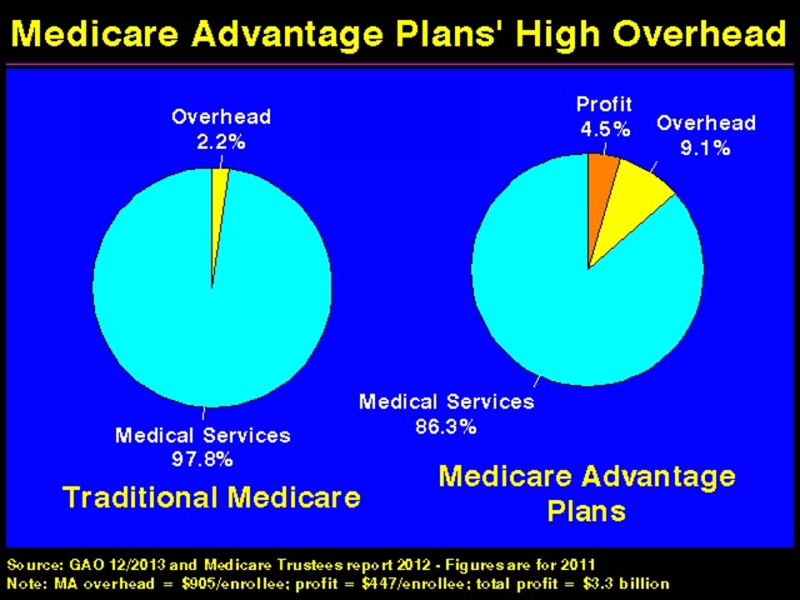
You can fight more effectively for single payer health care when you understand health policy. Here you have access to a slide set from Drs. Steffie Woolhandler and David Himmelstein. For instance, this slide shows that in traditional Medicare only a little over 2% goes to overhead, while in the private, for-profit Medicare Advantage plans almost 14% goes for overhead and profit. Learn and share. Knowledge is powerful.
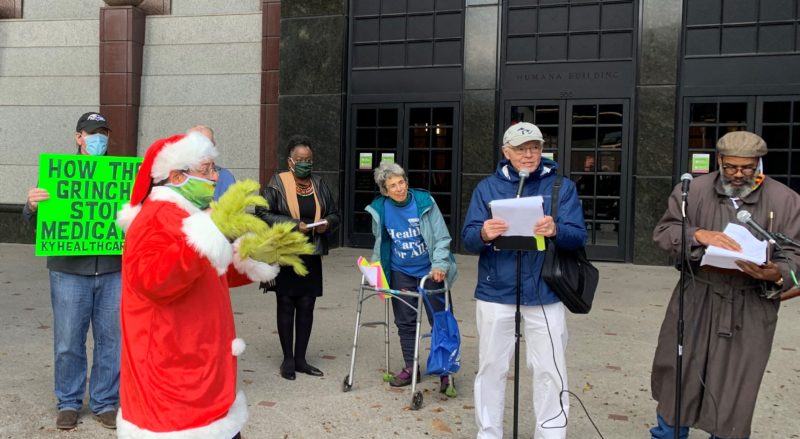
Steve Katz as the Grinch that Stole Medicare at Humana, one of 53 Direct Contracting Entities.
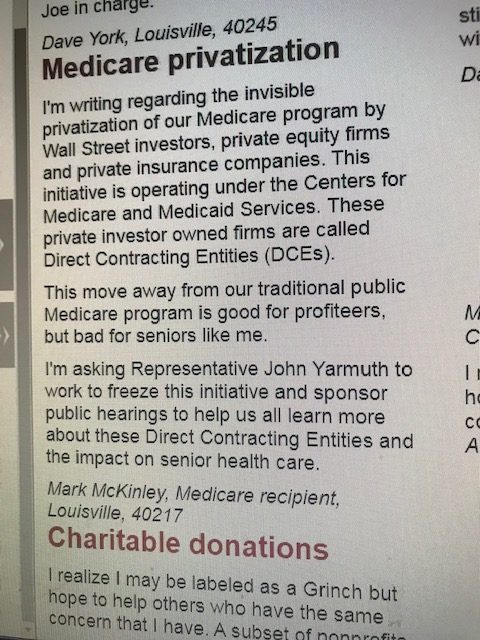
Over 50 Congresspersons, including Rep. John Yarmuth of KY, call on the Biden Administration to end the Direct Contracting Entities (DCEs) that are privatizing traditional Medicare.
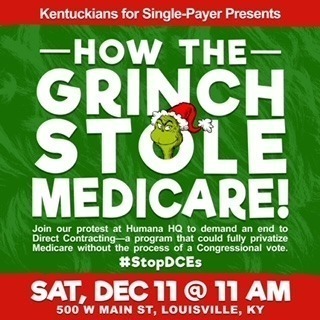
In the windy, late morning of Saturday, December 11, Kentuckians for Single Payer Health Care and community allies gathered outside the headquarters of Humana in downtown Louisville where they demanded an end to Medicare Direct Contracting Entities (DCEs), a program that could fully privatize Traditional fee-for-service Medicare without a vote by Congress.
Humana is one of 53 for-profit DCEs into which seniors who have chosen traditional Medicare can be placed without their consent.
As the post tornado winds howled through Humana’s marble pillars, Stephen Bartlett played his trumpet. Dr. Garrett Adams and the Rev. Ron Robinson read a poem about DCEs, “How the Grinch Stole Medicare”, while Steven Katz, in full Grinch costume, performed. Jill Harmer and Brian Daly led the group in holiday and health care songs, including one by Lee Stanfield of Tucson with the line about Medicare “Don’t Privatize It, Supersize it.”
Ann Hagan-Grigsby spoke from her vast community health care experience to point to the need to both save Medicare from privatization and to win a national single payer system that will cover everyone.
Kay Tillow urged everyone to take action by calling congress (1-202-224-3121) and Health and Human Services Secretary Xavier Becerra (1-202-205-5445) demanding that they end the DCE program. Local singer, songwriter John Gage had everyone joining him as he closed out the event with Pete Seeger’s “God’s Counting on Me, God’s Counting on You.”
Thank you to Harriette Seiler for providing the sound equipment, taking photos, and handling the media release, to Peg Box and Charlie Casper for making the phone calls, to Ron Hargrove and Rolf Friis for videos (see above), to NationalSinglePayer.com for the poem, and to all who worked and participated to make it happen.
As a result of publicity about the December 11 protest at Humana, Kentuckians for Single Payer Health Care has had the opportunity to do a number of interviews on DCEs. Here are two of them.
There must be a public outcry or we will lose Medicare.
Under a Center for Medicare & Medicaid Services (CMS) program now underway, more than 30 million seniors and disabled who chose traditional Medicare could be placed into largely investor-owned Direct Contracting Entities (DCEs) without the beneficiaries’ understanding or consent. We must not allow hedge fund managers to oversee our health care.
We will hold our protest in front of Humana headquarters because Humana has been identified as a DCE.
DCEs are yet another scheme to privatize Medicare. Like Medicare Advantage plans sold by the big insurers, the DCE program threatens traditional Medicare, and is designed to thwart the system our nation desperately needs–a publicly funded, improved Medicare for All. Everybody in; nobody out!
Tell Health & Human Services (HHS) Secretary Xavier Becerra to put a stop to DCEs. Call 1-877-696-6775. Also call your member of Congress urging a hearing on this topic. House 202-225-3121; Senate 202-224-3121. Learn more about DCEs at www.nationalsinglepayer.com
All of the other first world/industrial countries have health care systems whose function is to provide health care to all the citizens of each country. The purpose is simple in that the goal is to provide universal health care managed by the government. The method varies from government provided health insurance to a totally government-run health care system as in the United Kingdom. Funding also varies involving an assortment of taxation methods ranging from general taxation to multiple source funding, such as combinations of taxation (central and local), employer, employee and out-of-pocket sources. Some countries allow private health insurance, regulate fees, supervise and regulate drug costs. Health insurance is mandatory/compulsory in most and some countries do not allow for-profit health insurance.
The Scandinavian countries, the European Union, the United Kingdom, Canada, Australia, New Zealand, Japan, South Korea, Taiwan and some South American countries all have different forms of universal health care, functioning market economies and have not been bankrupted by providing this benefit to their citizens.
In the US, we have a health care industry, which functions in a magical arena, the competitive medical market place. While all those other first world countries consider health care an essential public service, in the US health care is a commodity to be exploited by an assortment of profit-seeking entities.
Most other first world countries have health care systems managed by the central government. In the US, we have a patchwork or more correctly a crazy quilt of different entities, some focused on providing health care and others focused on extracting profit from the health care industry. Medicare is government health insurance for older citizens and some with disabilities. Medicaid provides government health insurance as a federal/state collaboration for the poor and individuals with certain disabilities. Medicaid covers different things in different states. The US Public Health Service is trained to respond to national health crises and emergencies. The Army, Navy and Air Force all have health care systems within the Department of Defense providing health care to active-duty military and their families, retired military and dependents and politicians. Senators McCain and McConnell and Presidents Reagan and Trump were all treated at military facilities without cost. The VA health system, while not without challenges, generally does a good job caring for veterans.
And then we have the uniquely American approach to health care, over 1,000 for-profit health insurance companies whose primary goal is profit, not providing health care. Actually using the revenue from premiums charged to customers anticipating health insurance is considered a “Medical Loss Ratio”.1 The Medicare administrative costs are in the 2-3% range, for-profit health insurance companies are allowed to keep 20% as administrative cost as per the ACA and often find ways to keep higher amounts in certain plans.2 Each health insurance company may have 10-30 different plans with a range of premiums and coverage. The end result is an insanely complex and confusing health care environment inflicted on the American public.
How did we get into this mess? From the mid-1970s to the mid-2010s, the number of administrators/managers has increased by an astonishing amount: over 3,000%. There are now 10 managers/administrators for each physician.3 These people do not work in ICUs or ERs, they do not do COVID-19 tests or vaccinate. They may help, but they also interfere and are paid salaries that are often multiple times higher than the nurses, respiratory therapists and physicians who provide medical care.
The pharmaceutical industry functions without restraint, a very different situation compared to most other first world countries. Medicare is prevented by law from negotiating with the pharmaceutical companies, an astonishingly stupid economic policy.4 The for-profit health insurance companies extract hundreds of billions of dollars annually out of our health care as profit, outrageous administrative costs, advertising, political contributions and investor dividends.5 Over 60% of bankruptcies filed in the US are the result of citizens unable to pay medical bills, a situation that simply does not exist in most other first world countries.6
As disturbing as the current situation is, it is already getting worse. Private equity firms are purchasing nursing homes, hospitals, health systems, physician practices, outpatient surgery centers, laboratories, imaging facilities and whatever else they can get their hands on.7
The Wolves of Wall Street are about to devour US health care. The process involves buying the non-professional component of a practice, “improving efficiency” with the expectation of a return on investment of 15-30% annually and selling for a profit in three to five years.8 This is not meant to be a long, happy marriage. The investor invasion into health care creates the fundamental conflict of interest. “You can’t serve two masters. You can’t serve patients and investors”.7 About 70% of US nursing homes are investor owned.9 The resulting “improved efficiency” involves reduced staffing, increased use of medications and decreased quality of care.
The horror stories of patients left on toilets for hours, or lying in bed with unchanged loaded diapers abound. In one nursing home in Florida, a patient died from a feces-contaminated decubitus ulcer.10 When the family was understandably unhappy and hired a lawyer to determine accountability, they encountered a nightmare corporate structure. One company owned the building, another company obtained the license to run a nursing home, another company provided professional staff and another the custodial staff. The owners and managers had spread control among 15 companies and five layers of firms.
A large dermatology practice in California purchased by a private equity company produced a disturbing lesson in corporate governance.7 The practice’s “nonclinical” assets were bought by the private equity company, leaving the physicians in control of all medical decisions after agreeing to pay a management fee to handle administrative tasks such as billing and marketing. The new management team established daily and monthly financial goals, rewarding the offices meeting the goals with cash rewards. The performance of revenue enhancing procedures, Botox, laser treatments and Mohs surgery, for instance, was encouraged. Private equity groups buy existing labs and hire pathologists. The doctors are encouraged to send biopsy specimens to company owned labs and pathologists. Corporate approval was necessary to get office supplies, even toilet paper. Without consulting the medical staff, a manager changed to a cheaper brand of sutures and needles. The quality was so poor that needles would break off during injection and physicians had to dig them out of the skin and repeat the injection.
These are just a few examples of the litany of conflicts of interest between the goal of providing good patient care and the goal of feeding the investors’ profit demands. Sadly, we are left with the unanswered fundamental question of whether health care in the US is a commodity, to be exploited by for-profit companies and private equity investors, or is it an essential public service and a government responsibility. The rest of the first world knows the right answer.
This article was based on a number of radio programs on health care issues that were discussed on Single Payer Radio on Forward Radio WFMP-LP 106.5 FM. These programs are archived and can be listened to as podcasts by logging onto forwardradio.org-programs-single payer radio.
There must be a public outcry, or we will lose Medicare. Under a Center for Medicare and Medicaid Services (CMS) program now underway, more than 30 million seniors who chose Traditional Medicare could be placed into largely investor-owned Direct Contracting Entities (“DCEs”) without the beneficiaries’ understanding or consent.
DCEs are another scheme to privatize Medicare.Like Medicare Advantage, the DCE program threatens Traditional Medicare, as well as a future public and nonprofit Medicare-for-All program.
• Tell Health and Human Services Secretary Xavier Becerra to stop Direct Contracting Entities now!
Thanks to everyone who attended last night’s webinar on Direct Contracting Entities (DCEs), featuring Rep. Katie Porter, PNHP board member Dr. Ed Weisbart, journalist and scholar Trudy Lieberman, and David Lipschutz from the Center for Medicare Advocacy. If you missed it, I encourage you to watch the recording HERE.
In short, the DCE program was quietly launched last year by the Trump Administration as yet another scheme to privatize Medicare. Under this model, CMS could auto-assign more than 30 million beneficiaries who have chosen Traditional Medicare into largely investor-owned Direct Contracting Entities (“DCEs”) without the beneficiaries’ understanding or consent. Like Medicare Advantage, the DCE program poses an existential threat to Traditional Medicare, as well as a future public and nonprofit Medicare-for-All program.
I believe that we can stop the DCE program, but we must act quickly. Starting today, we are launching a petition demanding that HHS Secretary Xavier Becerra immediately halt the DCE program that was started under the Trump Administration, and protect Medicare as a public good for future generations.
While the petition is open to all, we have a specific goal of one thousand physician signatures before the end of October. Sign & share the petition If everyone who signs their name also collects ten additional signatures, we can reach our goal very quickly.
I know that the commercialization of Medicare — and DCEs in particular — are complex topics. Be sure to explore and share these resources as you talk with your colleagues and neighbors:
DCE one-page fact sheet Dr. Ana Malinow’s interview on the Thom Hartmann show (12 minutes) Dr. Ed Weisbart’s slide set: DCEs — Handing Traditional Medicare to Wall Street Webinar: Direct Contracting Entities — Handing Traditional Medicare to Wall Street Template for letter to elected officials
Traditional Medicare is in the crosshairs. Let’s sound the alarm about DCEs and demand the Biden Administration keep Medicare a public good for generations to come.
In solidarity,
Susan Rogers, M.D. President
Physicians for a National Health Program 29 E Madison St Ste 1412 | Chicago, Illinois 60602 312-782-6006 | info@pnhp.org
Please join us on Thursday, Sept. 23 at 8:00 p.m. Central / 9:00 p.m. Eastern to learn more about the quiet plan to privatize Medicare. Direct Contracting Entities (DCEs): Handing Traditional Medicare to Wall Street — What they are and how to stop them
This webinar will be co-hosted by PNHP and National Single Payer, and co-sponsored by Public Citizen, Social Security Works, All Unions Committee for Single Payer, UAW Region 1A Retirees, Kentucky State AFL-CIO, Kentucky Alliance for Retired Americans, and Western PA Coalition for Single Payer Health Care (so far).
Scheduled speakers include:
Rep. Katie Porter, (D-Calif.), signatory to a letter written to HHS Secretary Becerra asking for the immediate halt to DCEs
Dr. Ed Weisbart, Chair, PNHP-MO Trudy Lieberman, contributing editor, Columbia Journalism Review, and contributor to Health News Review and the Center for Health Journalism
David Lipschutz, JD, Associate Director, Center for Medicare Advocacy
What are Direct Contracting Entities and why should single-payer supporters be concerned? In 2020, the Trump Administration launched a new CMS experiment, the Global Professional Direct Contracting (GPDC) model, that was designed to privatize traditional Medicare. GPDC transfers cost and care management to private for-profit insurer and investor contracting entities (DCEs). Under this model, CMS could auto-assign more than 30 million beneficiaries who have chosen traditional Medicare into entities managed by private for-profit companies, without their understanding or consent.
Instead of halting this program, the Biden Administration has accelerated it, threatening the future of Medicare as we know it. If you care about preserving traditional Medicare for future generations — as well as for a future Medicare for All! — please join us on Thursday, Sept. 23 for this important webinar.
If you know of other organizations that would like to co-sponsor the DCE webinar, please contact Dr. Ana Malinow at anamalinow@gmail.com.